Purchase Price List Query

This program lets you view Purchase Price Lists and their associated detail lines.
Exploring
 Where it fits in?
This program lets you view Purchase Price Lists and their associated detail lines.
Things you can do in this program include:
-
Browse and filter Purchase Price Lists, then view header and detail lines in one place.
-
For each stock code on the list, review the price basis, price method, and basis price list link that governs how the final price is derived.
-
Drill into Quantity Discount Breaks (QDB) where applicable.
-
Confirm whether a list is applicable in determining purchase pricing by checking the Status (Blank - Active, H - On hold, R - In review)
This program is accessed from the Program List of the Syspro menu:
Program List > Purchase Orders > Purchase Pricing Engine
Terminology
Purchase Pricing engine
The Purchase Pricing Engine provides a simplified, single point of capture and maintenance for purchase prices, enabling configuration, data-driven supplier price lists, group-based pricing control and automated best-price selection at requisition and purchase order entry.
It extends the principles established by the Sales Pricing Engine to the Purchasing domain.
Purchase Price list
This indicates a dated collection of stock codes with prices, in a specified price basis (Stocking/Alternate/Purchase Price UOM)
A price method is specified for each price list, which may be a flat price (list price), a discounted price, or a quantity-discounted price.
You can define statuses against a Purchase Price List, such as Blank - Active, R - In review or H - On hold.
Only price lists that have a status of Blank - Active are included when the Purchase Price Query determines the best price.
Purchase Pricing method
The pricing method determines how the purchase price is calculated for each stock code in the Purchase Price List. It gets configured with in the Purchase Price List Maintenance program.
The available methods are:
-
List price
-
Discounted list price %
-
List price less Chain
-
List price less value
-
Mark-up price list
-
List price for QDB
-
List price less % for QDB
Purchase Price Expiry Date
The Purchase Price List expiry date refer to the end date after which a list is considered expired. Purchase Price Expiry Date Update and Purge can bulk-update this date or delete (purge) lists that have expired and are not in use.
Starting
Prerequisites
To use this program, the following setup option(s) must be configured appropriately:
Setup Options
Setup Options > Preferences > Distribution > Purchase Orders
-
Default Pricing Method for Entry
This must be defined as Purchase Price Group
This will enable the Purchase Pricing Engine behavior and exposes the Purchase Pricing Engine menu under the Program List.
Security
Activities
You restrict operator access to activities within a program using the Operator Maintenance program.
Groups
You can restrict operator access to programs by assigning them to groups and applying access control against the group (configured using the Operator Groups program).
Roles
You can restrict operator access to programs by assigning them to roles and applying access control against the role (configured using the Role Management program).
Configuring
The following configuration options in Syspro may affect processing within this program or feature, including whether certain fields and options are accessible.
Setup Options
The Setup Options program lets you configure how Syspro behaves across all modules. These settings can affect processing within this program.
Purchase Orders Preferences
Setup Options > Preferences > Distribution > Purchase Orders
-
Default Pricing Method for Entry
-
This must be defined as Purchase Price Group
Solving
Error messages
Purchase order setup pricing method
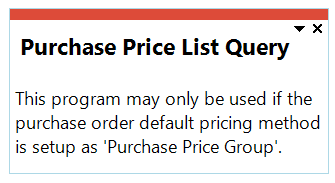
Cause
This message is displayed when you attempt to open this browse program before the Pricing Method setup option has been configured.
Solution
Ensure that the Default pricing method for entry setup option is defined as Purchase Price Group within the Setup Options (Syspro Ribbon bar > Setup > Setup Options > Preferences) before attempting to use any of the Purchase Pricing Engine programs.
Using
Hints and Tips
-
Columns in a listview are sometimes hidden by default. You can reinstate them using the Field Chooser option from the context-sensitive menu (displayed by right-clicking a header column header in the listview). Select and drag the required column to a position in the listview header.
-
Fields on a pane are sometimes removed by default. You can reinstate them using the Field Selector option from the context-sensitive menu (displayed by right-clicking any field in the pane). Select and drag the required fields onto the pane.
The captions for fields are also sometimes hidden. You can select the Show Captions option from the context-sensitive menu to see a list of them. Click on the relevant caption to reinstate it to the form.
If the Show Captions option is grayed out, it means no captions are hidden for that form.
-
Press Ctrl+F1 within a listview or form to view a complete list of functions available.
- A list of Purchase Prices can be printed using the Purchase Pricing List report (Program List > Purchase Orders > Purchase Pricing Engine > Reports)
- Purchase Price list detail can be printed using the Purchase Price Lists report (Program List > Purchase Orders > Purchase Pricing Engine > Reports)
Status Codes
Purchase Price list statuses
The following indicates the possible status codes that can be assigned to a Purchase Price List within the Purchase Price List Maintenance (Program List > Purchase Orders > Purchase Pricing Engine > Setup) program.
| Status | Description |
|---|---|
|
Blank - Active |
This indicates that the price list is effective and will be included when the Purchase Price Query program determines the best price. When the effective dates of a price list have lapsed, the status of that price list remains as Blank - Active, however it is no longer considered when determining the best price. |
|
H - On hold |
This indicates that a price list is retired and won't be considered when determining the best price. |
|
R - In review |
This indicates that the price list was created, but has not yet been used or is currently in the process of being updated or approved. A price list with this status won't be considered when determining the best price. |
Considerations:
-
The status of all existing Purchase Price Lists defaults to Blank - Active.
-
The status of newly created price list using the List price price method, defaults to R - In review.
Referencing
Purchase Price List
This lets you enter or select a unique purchase price list.
 Purchase Price List
| Field | Description |
|---|---|
| Purchase price list | This is a display and mirrors the content of the Purchase Price List from the toolbar. |
|
Description |
This indicates the description of the Purchase Price List |
|
Supplier |
This field is optional. It allows the Purchase Price List to be directly linked to the supplier. If the supplier has a default Purchase Price Group, ensure that it exists in the PorPriceGroupMaster table.
|
|
Currency |
This field will be disabled if the Purchase Price List is directly linked to a Supplier. The currency of the supplier will be displayed. |
|
Price basis |
This indicates the unit of measure on which the entire price list is based:
|
|
Price method |
This indicates the pricing method on which the price list is based: List Price
This assigns the list price to the stock code (as displayed at the List Price field in the Stock Code Maintenance (Program List > Inventory > Setup) program. This is the default price method. There can only be one effective list price per stock code, as this price is applied when there is no price group determining the stock code's price. Therefore, the start and expiry dates per price list for a stock code mustn't overlap.
Discount list price(%)
This assigns a discount percentage that is subtracted from an existing List Price list. This enables column Discount %1 in the Purchase Price List Detaillistview This option can only be used with an existing List Price type price list
List price less Chain
This assigns chain discount percentages that are applied to an existing List Price list. This enables columns Discount %1, Discount %2, and Discount %3 in the Purchase Price List Detaillistview This option can only be used with an existing List Price type price list
List price less value
This assigns a discount value to an existing List Price list. This enables column Discount in the Purchase Price List Detail listview This option can only be used with an existing List Price type price list
Mark-up price list
This assigns a mark-up percentage to an existing List Price list. This enables column Mark-up % in the Purchase Price List Detaillistview This option can only be used with an existing List Price type price list
List price for QDB
This assigns a List Price based on quantity discount breaks that have been defined. List price less % for QDB
This assigns a discount percentage to the price on the List Price, according to the quantity discount breaks that have been defined. This enables the hyperlink to quantity Discount Breaks in the Purchase Price List Detail listview |
|
Start date |
This indicates the date on which the price list comes into effect. This date drives the price list selection.
|
|
Expiry date |
This indicates the date on which the price list expires and is no longer valid. This date drives the price list selection.
|
| Quote date | This field is used for documentary purposes only. |
| Status |
Blank - Active
This lets you activate a price list so that it will be included when the Purchase Price Query determines the best price. When the effective dates of a price list have lapsed, the status of that price list remains as Blank - Active, however it is not longer considered when determining the best price.
H - On hold
This lets you deactivate a price list. A price list with this status won't be considered when determining the best price. R - In review
This lets you revise and modify a price list. A price list with this status won't be considered when determining the best price. |
Purchase Price List Detailed History Listview
| Field | Description |
|---|---|
|
Stock code |
This indicates the stock code for which the price list is applicable. |
| Price basis |
This indicates the unit of measure on which the detail line is based:
|
|
Basis price list |
This lets you select the basis price list to which the discount, mark-up percentage or quantity discount break in this price list is applied. This is enabled for all price list except List Price and List Price for QDB A base price list is required for the following price methods.
|
|
Price |
This indicates the actual price of the stock code. This is enabled for List Price and List price for QDB. |
|
Lead time |
This default to the supplier stock code reference or if the Price List is by currency, then it will default to the Inventory Master Replenishment. |
|
Discount % 1 |
This indicates the first discount percentage. This apply to the Discount list price(%) and List price less Chain price method. |
|
Discount % 2 |
This indicates the second discount percentage. This apply to the List price less Chain price method. |
| Discount % 3 |
This indicates the third discount percentage. This apply to the List price less Chain price method. |
| Mark-up % |
This indicates the mark-up percentage. This applies to the Mark-up price list price method. |
| Discount break |
This hyperlink lets you view the Quantity Discount Breaks (QDBs) This applies to the List price for QDB and List price less % for QDB methods. |
| Minimum order qty | This indicates the minimum order quantity. |
| Qty multiplier | This indicates the quantity multiplier. |
Copyright © 2026 Syspro PTY Ltd.